The results for the NZNO Board/National Executive election are in. Thanks to all the NZNO members who voted.
I am especially grateful for your support, which meant that I once again topped the poll. I eagerly look forward to working with the new team.
Turnout at 6.86% is actually up from the 6.31% voter turnout in 2022. Only twice since NZNO took its current form in 1993 have more than 10% of members participated in our elections.
A focus for me on the new National Executive will be to help our elected leadership connect more closely with the wider membership and demonstrate our relevance, so that we might break this historic pattern of low turnout as we go forward together.
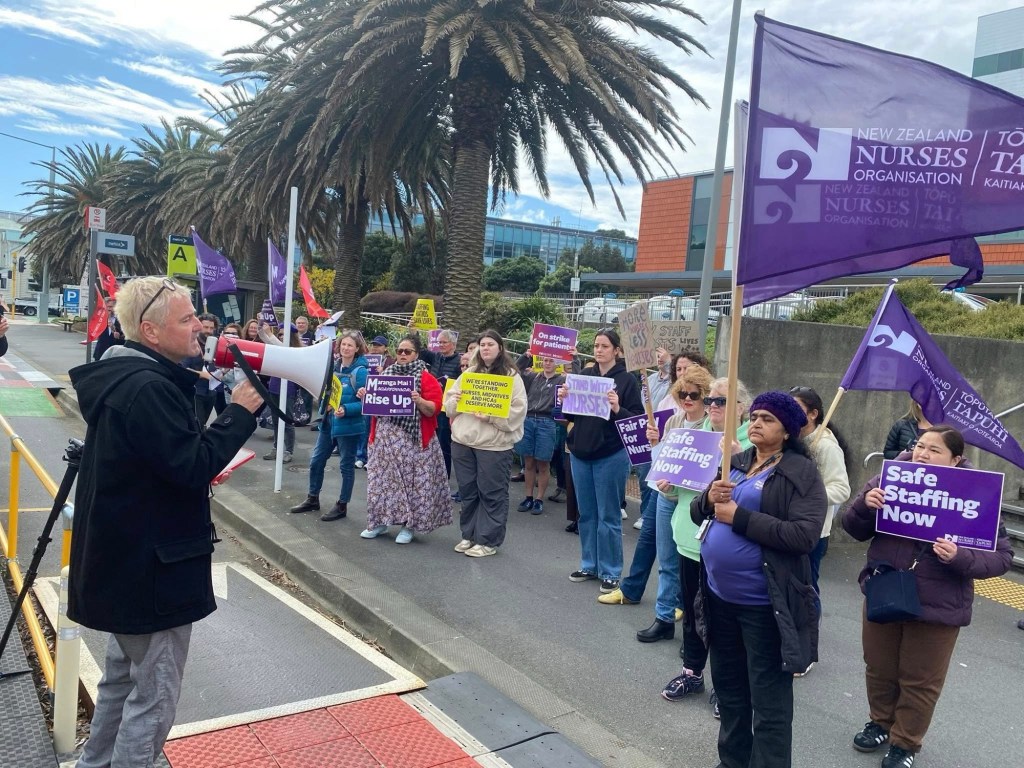
Kia ora koutou, My name is Grant Brookes. I am a Mental Health Nurse here at Wellington Regional Hospital Ngā Puna Wai Ora, and I’m an NZNO delegate. At our last strike in July, we had NZNO President Anne Daniels speaking to us. She is in Ōtepoti Dunedin today, supporting the picket line down there, so I’ve been asked to speak. I’ve got notes that have been sent through containing some of what she wanted say. 𝐁𝐮𝐭 𝐰𝐡𝐲 𝐚𝐦 𝐈 𝐨𝐧 𝐬𝐭𝐫𝐢𝐤𝐞 𝐭𝐨𝐝𝐚𝐲? I’m on strike today because I care about staffing and patient safety. I love my job as a Te Whatu Ora nurse, but understaffing prevents me doing the job I love. I started work at Wellington Hospital in 2002. I’ve seen many changes over the years – and recently, changes for the worse. The understaffing in 2025 is so critical that I am unable to do the most important part of my job – talking with people, hearing them in their distress and supporting them through it. I work in mental health. What does today’s understaffing look like in our area? Through my role as an NZNO delegate, I have access to Te Whatu Ora’s real-time data on understaffing in the Mental Health, Addictions and Intellectual Disabilities Service. Across MHAIDS last month, 12.7% of all hours worked were overtime. That means that on average, one staff member in 8 on any given shift is working overtime. And even with an average of one or two staff members on each shift working a 16 hour day, in August our Directorate experienced Critical Care or Significant Care deficits on day shifts fully one third of the time, according to Te Whatu Ora’s own figures. This care deficit means stressed and burnt out staff. But what does it mean for our tāngata whaiora, our patients? As our ED colleagues can confirm, it means that our tāngata whaiora can sit in the Emergency Department for days on end waiting to be admitted – surrounded by patients in states of distress, or behaving in a way that causes distress to others. It can mean our tāngata whaiora waiting months – or even years – for specialist mental health rehabilitation. Or it can simply mean that they get turned away from accessing mental health services altogether, because there aren’t the resources to provide care. The impact is greatest of all for our Māori and Pacific peoples. We see the evidence of the growing number of people turned away daily on our city’s streets. 𝐖𝐡𝐚𝐭 𝐢𝐬 𝐭𝐡𝐞 𝐧𝐚𝐭𝐢𝐨𝐧𝐰𝐢𝐝𝐞 𝐬𝐭𝐫𝐢𝐤𝐞 𝐚𝐛𝐨𝐮𝐭?
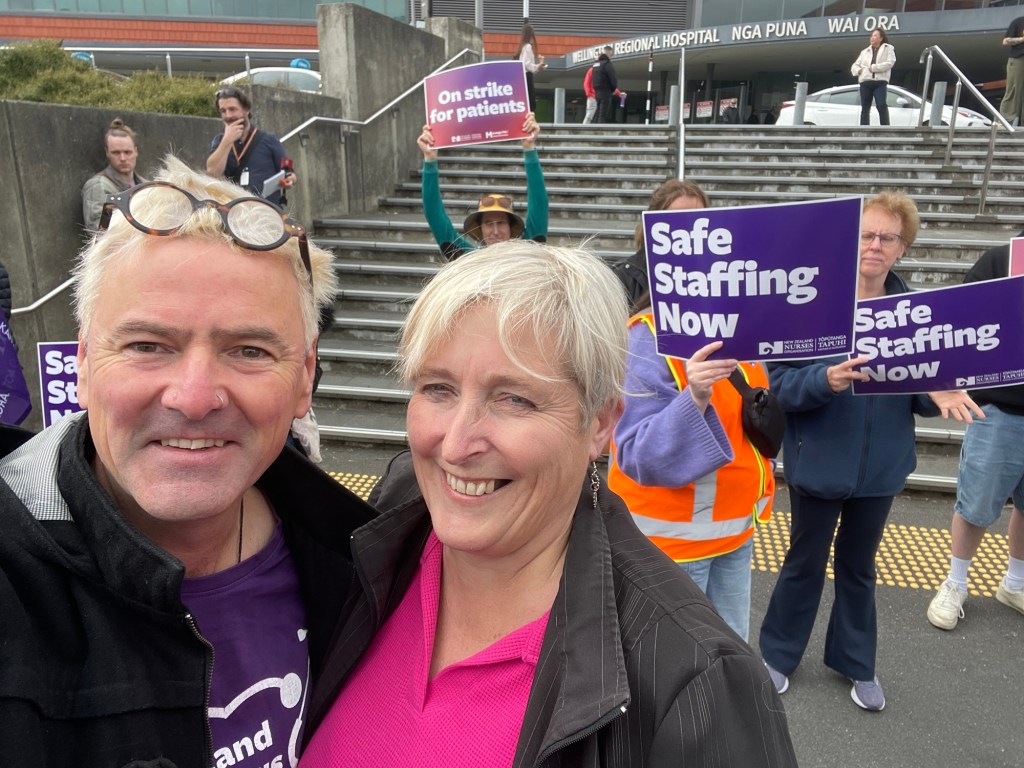
It was fabulous to have the support of other unions and both the outgoing NZCTU President Richard Wagstaff and President-elect Sandra Grey on our picket line.
More than 36,000 Te Whatu Ora nurses, midwives, health care assistants and kaimahi hauora voted for this further strike action after Te Whatu Ora failed to resolve ongoing concerns about understaffing like these. We voted – and I voted – strongly to go on strike on two days from 7am to 11pm on Tuesday 2 September and Thursday 4 September. NZNO members are clear that we want to keep fighting for the safety of our patients and to reduce preventable patient deaths. We have had enough of our patients waiting for care – or missing out entirely – because we’re too busy to get to them. We became healthcare workers because we want to help people and give them the care they need. Not risk their suffering due to a lack of staff. Patients are at risk because the Coalition Government is choosing cost cutting over patient need. We don’t get paid for striking but we do it for the sake of our patients. Te Whatu Ora needs to do more to retain our nursing workforce, employ graduate nurses and ensure patients get the care they need. There were 30,000 New Zealanders who moved to Australia in the past year. We all know some of our nursing colleagues who burnt out and moved there for better conditions and wages. We need more Māori and Pacific nurses so there are culturally appropriate ratios that ensure the right nurses are caring for the right patients at the right time. Despite Te Whatu Ora’s and the Government’s denials, Aotearoa desperately needs more nurses, midwives, health care assistants and kaimahi hauora. Better pay and conditions would make nursing more attractive and help keep the nurses we have. To fix understaffing and ensure patient safety we’re calling for the following: 1. We need mandatory, culturally-safe staff-to-patient ratios. 2. We need Te Whatu Ora to recommit to CCDM for safe staffing. 3. We need the full employment of new graduates. We’re here to fix the health system and we won’t stop. It’s going to require a long-term effort from NZNO members to win the safe staffing that we and our patients need, and today is just the start. So let’s finish with a chant. – When patient safety is under attack – stand up, fight back – When nurses rights are under attack – stand up, fight back – When health care assistants are under attack – stand up, fight back – Health workers, united, will never be defeated!
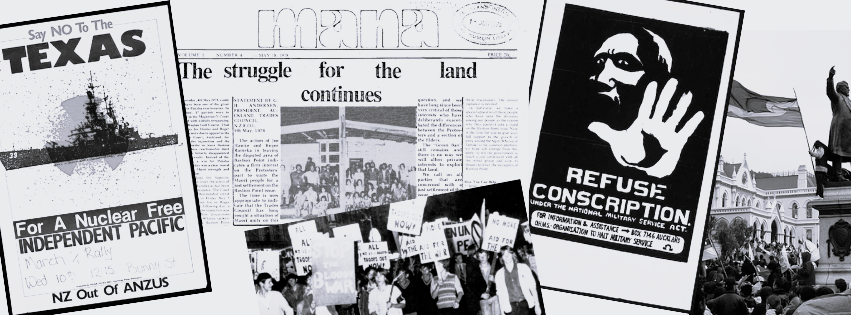
Confronted today with dismal Right Wing governments at home and overseas, it’s easy to feel powerless. But mass popular movements can beat back governments – especially when these are backed up by active support from workers and unions. In fact, we’ve beaten the government in Aotearoa many times before. Sometimes we scored quick victories. Other times, the success of a mass movement only became apparent years later.
The history of successful mass struggles is usually covered up or, if it’s too big to hide, the history gets rewritten to make it seem like the success was due to some beneficent politician or state institution. With the amazing Hīkoi Mō Te Tiriti and Palestine solidarity protests still resonating across the motu, here are a few past examples to show what we can achieve.
#Landback
The colonisation of Aotearoa caused the alienation of 95 percent of Māori land. Treaty settlements have resulted in the return of land, although the amount of land returned and compensation paid is a pittance. Historian Vincent O’Malley calculated in 2018 that, “Treaty settlements typically return 1 to 2 percent of what was lost”. What is less widely known is that the return of land through the Waitangi Tribunal started because of mass mobilisations and industrial action by trade unionists.
The Waitangi Tribunal was established in 1975, as a result of pressure from a rising protest movement which culminated in the 1975 Land March. For its first ten years, it couldn’t examine breaches of Te Tiriti which occurred before that date, rendering the Tribunal largely useless.
On 5 January 1977 Māori from the hapū Ngāti Whātua Ōrākei, supported by communists and other activists, began an occupation at Takaparawhau Bastion Point. This last remaining block of Māori land in Tāmaki Makaurau Auckland had been confiscated by the government in stages from the late 1850s until World War Two. In 1976, the National government under prime minister Robert Muldoon announced plans to sell it off for an up-market housing development. Māori demanded its return.
For 506 days, the occupiers resisted eviction. The Auckland Trades Council, the city’s union leadership, declared a “green ban” on the site, so that no union member would be allowed to build Muldoon’s mansions. On 25 May 1978, Muldoon ordered the New Zealand Army, backed by Air Force helicopters, to invade Takaparawhau and attack the people. The operation was later described as “the largest peacetime force of police and army in recent history” by Māori Affairs Minister Pita Sharples. But the green ban remained, and the mansions didn’t get built.
The land sat vacant until a law change in 1985 enabled the Waitangi Tribunal to investigate historical breaches of Te Tiriti. In 1987 the Tribunal recommended the return of Takaparawhau to Ngāti Whātua. The government, even after deploying military force, accepted that it was beaten. A decade on from the occupation, mass struggle backed by industrial action forced the return of the first block of Māori land under the Treaty settlements process.
Aotearoa’s nuclear free foreign policy has become part of this country’s national mythology. This mythology contains elements of truth, overlaid with ruling class ideology. Clips of Labour Prime Minister David Lange at the 1985 Oxford Union debate regularly resurface in the media. His famous quip that he could “smell the uranium on the breath” of a heckler made him look like an anti-nuclear champion. It reinforces the commonly-held view that he was the one who led Aotearoa out of the ANZUS nuclear alliance with the United States. In reality, Lange fought against the people who made Aotearoa nuclear-free.
The first nuclear warship to be welcomed to our waters was the USS Halibut, invited by Labour Prime Minister Walter Nash in 1960. Three more followed in 1964. When visits resumed after a hiatus in 1976, they were met with mass protests. As the USS Truxtun sailed into Wellington harbour on 27 August that year, waterfront workers launched a strike which lasted for the six day duration of its visit. No cargo moved. No inter-island ferries sailed. The Truxtun was unable to berth and had to anchor off shore.
Other Wellington workers also took strike action in protest, including the cleaners at the US embassy. The USS Long Beach got the same reception when it visited Auckland two months later.
Demonstrations grew in size with each visit. On Hiroshima Day 1983, as the USS Texas lay berthed in Auckland, 50,000 people took to the streets in protest. The mass movement shifted public opinion. In 1979, polls showed 61 percent of people willing to allow visits by nuclear armed warships. By 1984, 57 percent were opposed.
Propelled by the mass movement, delegates to the 1983 Labour Party Conference voted for a policy that: “The next Labour Government… will continue to oppose visits to New Zealand by nuclear powered and/or armed vessels and aircraft.” As Lange later admitted in his book, Nuclear Free – The New Zealand Way, he fought against it. “I argued against withdrawal from the alliance at party conferences and delegates hissed in ritual disapproval.” Elected as Prime Minister the following year, he defied his own party and told US secretary of state George Schulz, “nuclear-powered vessels which were proved safe and were not carrying nuclear weapons would be allowed to visit”. According to US ambassador H. Monroe Browne, Lange asked him to wait six months for the public to “cool off” and then restart the ship visits.
It was only the strength of the anti-nuclear mass movement, when the news broke of a planned warship visit in 1985, which forced Lange’s hand, defeated US imperialism and ended Aotearoa’s participation in the ANZUS nuclear military alliance.
It’s not widely remembered these days, but it used to be compulsory for young people in Aotearoa to join the military. All males had to register on their 19th birthday with the Department of Labour, and if your name was drawn in a ballot, off to the army you went. The campaign of civil disobedience to end conscription is one of the most spectacularly successful people-powered movements in this country’s history – scoring complete victory in little over a year.
The campaign began in Pōneke on 22 February 1972, at a small meeting of students in the Victoria University Students Association building. They settled on a name, Organisation to Halt Military Service or OHMS, being a pun on the unit of electrical resistance (ohms) and the stamp on official government postal envelopes at the time, On Her Majesty’s Service.
National chair of OHMS, Robert Reid, recently recalled that “it was no use being an individual martyr for the cause and it was necessary to build a nationwide movement of 19 year olds refusing to register for military service, even if this lead to huge fines, which if unpaid would lead to prison sentences”.
The main strategy was one of non-compliance. Many young men, on reaching the age of 19, broke the law by refusing to register for military service. For this, OHMS co-founder Geoff Woolford, a first year teacher at Taita College, was sent to prison.
As the campaign continued, other young men who had already been forced into training deserted military camps to join the new group of resistors. As OHMS grew, it forged links with Māori activist groups like Ngā Tamatoa. A 19-year old Tame Iti was one who refused to register.
OHMS found imaginative ways to resist. They found that filling in false compulsory military training registration forms, giving names like Micky Mouse or Prime Minister Keith Holyoake, completely disrupted the system. The campaign also included hoax bomb threats, setting off fire alarms and smoke bombs to disrupt the conscription ballot at the Labour Department head office.
The law requiring compulsory military service was repealed in 1973. Although OHMS claimed the victory, veterans of the anti-conscription campaign are quick to acknowledge that the power to win came from the mass protests against New Zealand’s involvement in the US war of aggression in Vietnam. These peaked with huge nationwide demonstrations on 30 April 1971, backed by the trade unions, which drew 35,000 people onto the streets.
David Seymour’s ambition to privatise our public health system isn’t the first time that a Right Wing government has tried it. When National was elected in 1990, it set about transferring ownership of our hospitals to companies called Crown Health Enterprises. In 1992, the Government started charging all public hospital patients and moved to break the power of unions in the health sector. Labour Party leader Michael Moore said, “the introduction of user part-charges marked the second stage of the Government plan to privatise health.” Maurice Williamson, the associate Minister of Health, publicly refused to rule out privatising public hospitals after the 1993 election.
The government’s plans were met with a mass revolt. The Coalition for Public Health brought together a vast array of opponents including the country’s biggest trade unions, the Public Service Association and Engineers Union, medical workers organisations, nurses’ unions, and many community and religious organisations that spanned from the National Council of Women to the Anglican Church.
Protests took place outside hospitals from Whangarei to Timaru in 1992 to mark the last day of free hospital care. Wellington Hospital nurses defied orders from their managers to issue invoices to patients, and all the unions on site resolved to “support any staff disciplined for refusing to invoice patients or collect money.” The Service Workers’ Union, one of the largest in the country, urged their members to boycott the hospital charges, and offered legal support to boycotters if they needed it. Hospital staff from laboratory workers to cleaners and nurses went on strike. Doctors took strike action for the first time.
By April 1993, the number of New Zealanders with unpaid hospital bills had swollen to more than 20,000. Prime minister Jim Bolger sacked the Health Minister, and his replacement announced that charges for hospital stays would be scrapped – although outpatients would still have to pay for hospital appointments. The boycott continued.
By 1997 there was a non-payment level of at least 25 percent and 50,000 boycotters were being pursued by debt collectors. The last plank of the privatisation plan had to be abandoned. Once again, a people-powered mass movement had beaten the government.
EDUCATED HEALTH professionals are aware of the statistics – 735 healthcare workers killed in Gaza and the West Bank, according to the World Health Organisation, with a further 919 injured in Israeli attacks and 129 healthcare workers detained.
There are now over 120,000 fatalities and injuries – a majority of whom are women and children – in what the ICJ says are plausible acts of genocide. The WHO has also documented over a million cases of communicable diseases in Gaza since October.
Why are New Zealand’s medical colleges silent?
Of the 18 professional bodies belonging to the Council of Medical Colleges, 17 have made no public statement on the Gaza genocide, despite appeals from their own members. Specialist associations have been similarly silent. The contrast with the Russian invasion of Ukraine could not be starker.
Individual doctors who speak up face disciplinary proceedings. For the first seven months of war, the NZ Women in Medicine Facebook group banned all mention of Gaza – going as far as removing posts simply marking Ramadan.
Other health professional bodies have spoken out – Nurses, Midwives, Social Workers, Dieticians and other Allied Health groups. Māori health professional bodies have been vocal.
But all medical professionals have both moral and ethical obligations to advocate for the right to health in every instance where it does not exist, and for every human being it does not exist for.
The ongoing silence of our medical colleges is a stain on our profession. To restore our moral standing, we must speak up for our colleagues, for women and for the right to health for all in Gaza.
Besan’s story
THIRD YEAR medical student Besan Helassa posted about her hopes and fears on X last October. “I have dreams I have not yet fulfilled,” wrote the Palestinian trainee doctor. “I have a life that I have not fully lived. I have a family that I love and fear for.
“If we are all exterminated by this barbaric occupation, our crime is simply that one day we defended our land that was stolen from us and demanded our basic rights as human beings. We will not forgive the whole world.”
Besan died in an Israeli missile strike on her home on 14 October 2023. She was 19 years old.
Sign the open letter to medical bodies
A month ago, Aotearoa Healthcare Workers for Palestine wrote to the medical colleges and professional associations, calling on them to break the silence.
AHW4P was formed in November 2023, around an open letter to the New Zealand Government. Signed by over 1,500 people, it demanded an immediate ceasefire and for all parties to uphold international humanitarian law.
AHW4P has a 14-member interim committee – made up of Doctors, Nurses, Health Care Assistants and Allied Health professionals from Tāmaki Makaurau down to Ōtautahi.
Our Chairperson is Dr Ruba Harfeil, a Palestinian GP in the Waikato.
Our mission statement acknowledges that the colonial violence in Aotearoa and Palestine is connected. We are holding our inaugural AGM in July. Apply to join at facebook.com/groups/ahw4p or email ahw4p2023@gmail.com.
On 11 October, the fifth day of the war on Gaza, emergency services at Al Shifa Hospital received a call from a nearby neighbourhood. The assault by Israeli Occupation Forces (IOF) had caused mass casualties in the vicinity of the Karni Crossing.
Palestinian Red Crescent ambulances had to wait to receive clearance from Israel. The green light came, and paramedic Hatem Awad raced to respond. Before he could arrive at the scene, his ambulance was targeted and hit by an air strike. Hatem was the fourth paramedic killed by the IOF that day. After nearly six months of war, 410 Israeli attacks on healthcare have resulted in 685 fatalities and 902 injuries and damaged 99 facilities and 104 ambulances, the World Health Organisation reported on 19 March. But these aren’t just numbers. They are people, like Hatem.
Hatem Awad stands beside his ambulance
Coupled with the blockade of medical supplies, fuel for hospital generators, food and water, Israel has engineered the total collapse of a healthcare system serving more than two million people.
Aotearoa Healthcare Workers for Palestine (AHW4P) was formed a month after the outbreak of the war on Gaza, in response to this pending catastrophe and war crime. We came together around an open letter calling on the New Zealand Government to demand an immediate ceasefire and for all parties to uphold international humanitarian law.
The letter quickly garnered more than 1,500 signatures from healthcare workers and was presented at Parliament on 21 November. We established a 14-member interim committee – made up of doctors, nurses, healthcare assistants and allied health professionals from Tāmaki Makaurau Auckland in the north down to Ōtautahi Christchurch in the south – headed by Dr Ruba Harfeil, a Palestinian doctor now practising as a GP in rural Waikato. We agreed a mission statement acknowledging that the colonial violence in Aotearoa and Palestine is connected. We created a closed Facebook group for organising and a public Instagram account.
Over the succeeding weeks and months, we have organised and participated in many solidarity actions within the health sector and in the wider Palestine solidarity movement.
International links to similar groups overseas led us from the outset to participate in Friday vigils by healthcare workers worldwide, inspired by a vigil in London in November which captured global media attention.
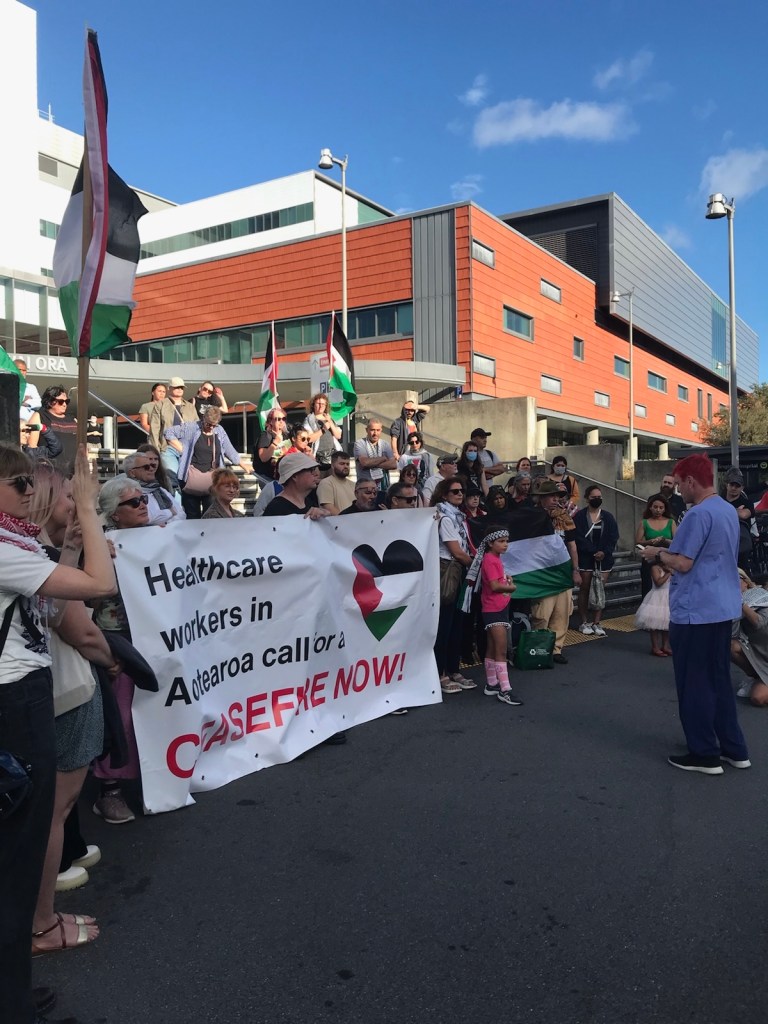
A Friday vigil at Ngā Puna Waiora Wellington Regional Hospital
We also participate as a contingent in the many rallies and marches which have been taking place across Aotearoa, highlighting the impact of Israel’s war on the health of the Palestinian population, and issue media releases.
An AHW4P contingent march in Tāmaki Makaurau
On International Working Women’s Day, we organised a powerful vigil outside the Israeli Embassy.
We have been less successful in our lobbying of medical professional bodies which, with the exception of Te Ohu Rata o Aotearoa Māori Medical Practitioners, have rejected our calls and remained silent in the face of genocide. Despite this, we persist. This month we surveyed the candidates standing for election to the Medical Council of New Zealand. We are in talks with the New Zealand Women in Medicine conference organising committee and are in the process of writing to all of the medical colleges and specialist associations.
Our work continues to achieve a just and peaceful future for Gaza healthcare workers like Hatem Awad and for all Palestinian people. We invite any healthcare worker in Aotearoa who supports our mission to join us.
• Reposted from iso.org.nz. Thanks to the International Socialist Organisation for accepting publication of this article.




 Grant Brookes | Nurse & Trade Unionist