On the eve of World War One, New Zealand’s labour movement was approaching a crossroads. Down one path lay an end to imperialist slaughter on foreign fields and liberation from colonial capitalist oppression at home. Down the other, government by two alternating parties who differed over how to administer capitalism, but who were equally committed to maintaining the brutal system of exploitation and war.
Today, we know the path our history took. As working class uprisings shook the capitalist world in the aftermath of the war, leading briefly to a beacon of hope in revolutionary Russia, this country laboured under its most authoritarian, far-right government in history – even more oppressive even than today’s Coalition. The revolutionary potential of the pre-war years was extinguished. By 1919, Aotearoa’s leading union newspaper declared: “The very forms of what is called democracy were set aside”, as the government “passed needless regulations restricting freedom of speech, act, and movement, and generally acted as dictator and autocrat.”
It is said that those who do not learn from history are doomed to repeat it. So the question is, how did this disaster happen?
It didn’t have to be this way. Although few today know it, striking workers courageously battled armed militia on horseback, backed by Royal Marines with machine guns, in running street fights during a general strike in 1913. Editorials, like one in the West Coast Times, fumed and fretted that, “The seed of revolution is here, nevertheless. During the last few weeks sedition, anarchy and the worst form of syndicalism have been preached from housetops; lawlessness and riot have been indulged in; there have been revolver shots in our streets and plants of explosives have been found.”
But as author Martin Gregory explains, the “real turning point” for the labour movement came the year before. His newly-revised and updated pamphlet, The Significance of the Waihi Strike, describes and analyses this decisive struggle of 1912 – one which would determine the course of history. Rich in detail and vivid first-hand accounts, it’s a must-read for every socialist.
The dispute at the Waihi Gold Mining Company began over whether unionised workers would have the right to negotiate and take strike action if necessary, or whether their terms and conditions of employment would be taken out of their hands and decided by a specialised tribunal called the Arbitration Court.
In 1911, members of the Waihi Miners’ and Workers’ Union had voted to cancel their registration with the Arbitration Court and deal directly with the company. Immediately, pay rates went up and a competitive tendering system, which pitted miner against miner for the right to work, was abolished. They joined a small but growing number of other unions moving in the same direction. These unions were organised nationally as the New Zealand Federation of Labour, known as the “Red Feds”.
“But all the gains could be put at risk by an arbitrationist union being recognised”, explains Martin Gregory. “A tiny registered union at Waihi could become the recognised union and the awards of the Arbitration Court would then be binding on all 1,200 workers in the Waihi mining industry.”
Company executives set about luring workers to leave the Waihi Miners’ and Workers’ Union, create a rival union and register with the Arbitration Court. By May 1912, the company had convinced a sufficient number – some 25 to 30 workers – to commit this treachery. So began the six-months-long Waihi Strike.
The 1912 Federation of Labour Conference was timed for the end of May. “At once”, says Martin, “there was a call for the Federation to support the Waihi strike.” But there was disagreement among delegates over what kind of support to provide, and whether other unions would strike in solidarity with the miners. “The upshot of the conference, as far as Waihi support was concerned, was that the Federation would levy members at 10 percent of their weekly pay to support the strikers, but the action would not be extended.”
Midway through the conference, “the Liberal government was defeated on a confidence vote. William Massey’s right-wing Reform Party was to take office in July.” This would prove a momentous development.
“From May to August the Waihi Strike passed peacefully… For the first phase of the strike, the employers relied on hunger to work its wonders; then it became clear that the strikers’ families were not going to be starved into submission. The new Right wing Massey government and the employers made their plans.”
“In early September, police commissioner Cullen went to Waihi to personally supervise a crackdown.”
“On 2 November mounted police charged a crowd of strikers.” This was just a taste of the violence to come. Nine days later, “a force of thugs and scabs attacked the union hall with a hail of missiles as the Police looked on.” The following day, police and scabs ransacked the union office, gun shots rang out and miner Fred Evans was fatally struck by a police baton. Hundreds of strikers and their families were run out of town. “The strike was effectively over, although not officially declared off until 30 November. Before the year was out, the competitive contract system was back.”
As well as describing these events, The Significance of the Waihi Strikegoes on to analyse why they happened. As the author has it, “The lessons to be drawn from the strike are profound and are still relevant to the working-class movement today.”
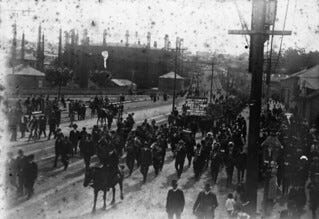
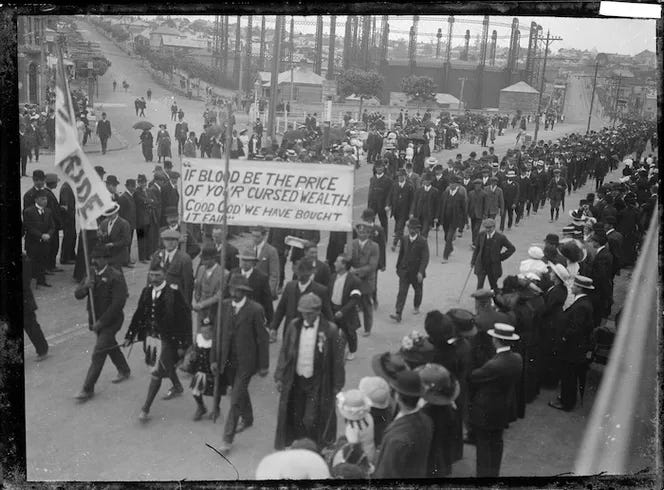
Labour movement procession turning from College Hill into Victoria Park, Auckland, 1913
The first key lesson in the pamphlet is this: “The union side’s mustering of financial aid to prevent the strikers from being starved back to work was not equal to the brutal intent of the goldmining companies. Only by drawing other workers into the struggle could the capitalist class have been strategically outflanked and the Waihi strikers defended from violence.”
The second key lesson is about why other workers were not drawn into the struggle.
The Red Feds, to which the Waihi Miners’ and Workers’ Union belonged, did not represent the majority of union members. “By February 1912 the Federation had 43 affiliated unions with 15,000 members out of 67,000 unionists all told.” A larger number belonged to arbitrationist unions, grouped together under local Trades and Labour Councils.
“The Federation of Labour was known as the ‘Red Fed’, with good reason: the Socialist Party and the Federation of Labour were intimately bound together.” The Red Feds’ constitution proclaimed: “Instead of the conservative motto: “A fair day’s wages for a fair day’s work,” our watchword is “Abolition of the wages-system.”
On the other hand, the Trades and Labour Councils were connected to the United Labour Party, a forerunner of today’s pale Labour Party. Under this collaborationist leadership, appeals for solidarity met responses like the one from the Wellington Trades and Labour Council: “we are not prepared to assist in any way, nor can we recommend our affiliated unions to render any assistance.”
Yet the pamphlet also argues that, “the tactics pursued by the leadership of the Waihi Strike were fatally flawed.”
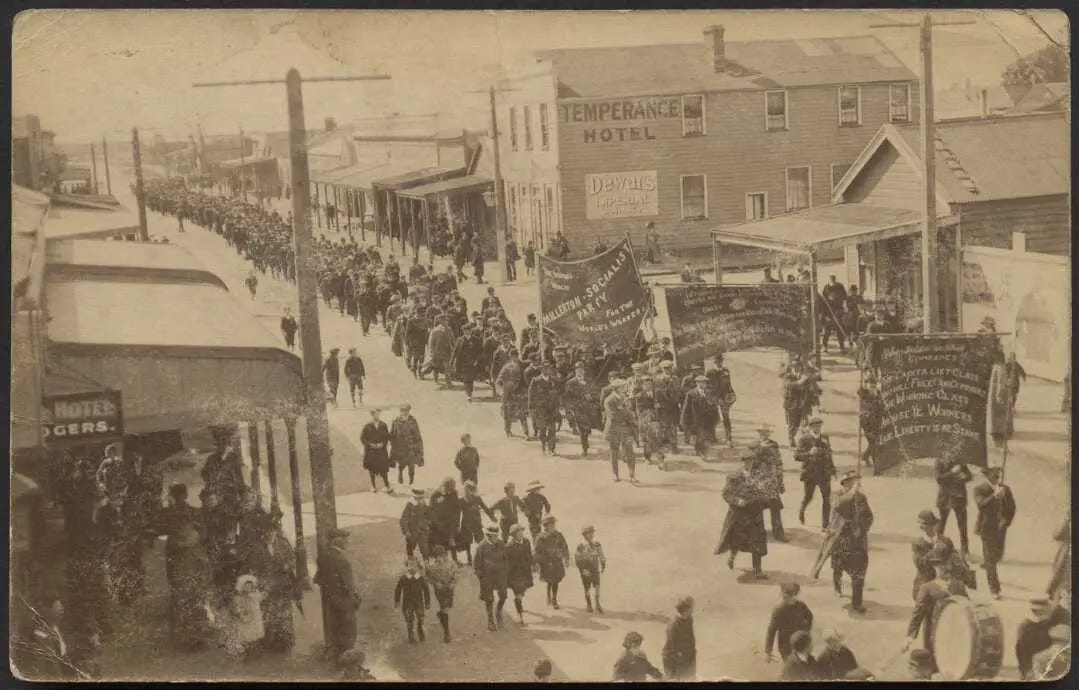
Millerton Socialist Party march during the Waihi miners’ strike, Waihi
Founded in 1901, the Socialist Party was “nominally Marxist and revolutionary”, yet it “contained a diverse range of reformist and revolutionary tendencies.” Some members also showed signs of a white supremacist colonial mindset, hindering the party’s ability to unite Māori and Pākehā.
Even among the revolutionaries there were three competing schools of thought. “The first attached equal weight to the twin pillars of revolutionary politics and industrial unionism.” “The second strain of revolutionary ideology took only one of the two wings, industrial unionism, and placed it at the centre of the struggle for socialism.” Swayed by these syndicalist ideas, the second group downplayed the critical significance of developments in parliament. The third group made the opposite mistake, eschewing industrial struggle, believing instead that, “the revolution would be achieved by a class-conscious working class via the ballot box.”
Increasingly divided among themselves, the Socialist Party leaders in the Red Feds wavered at critical moments, failing to take decisive action and draw other workers into the struggle. At one point boasting a membership of thousands, by the end of 1913 the Socialist Party had largely collapsed.
The Significance of the Waihi Strike concludes with this:
“The Waihi Strike and the Great Strike of 1913 took place when the New Zealand working class reached unparalleled heights of militancy that have not been matched since.”
“The strike precipitated the process by which the working class rid itself of the hold of Liberalism and hence forward increasingly support its own party for decades to come. However, this party would be the Labour Party, so very different to the Socialist Party that had inspired so many workers to fight for the replacement of capitalism with socialism. Frederick Evans, the Waihi strikers and their families will be avenged when once again the working class has a party dedicated to the abolition of the wages system.”
• The Significance of the Waihi Strike, 2nd Edition, by Martin Gregory is published by the International Socialist Organisation Aotearoa. If you are interested in a copy, please contactcontact@iso.org.nz
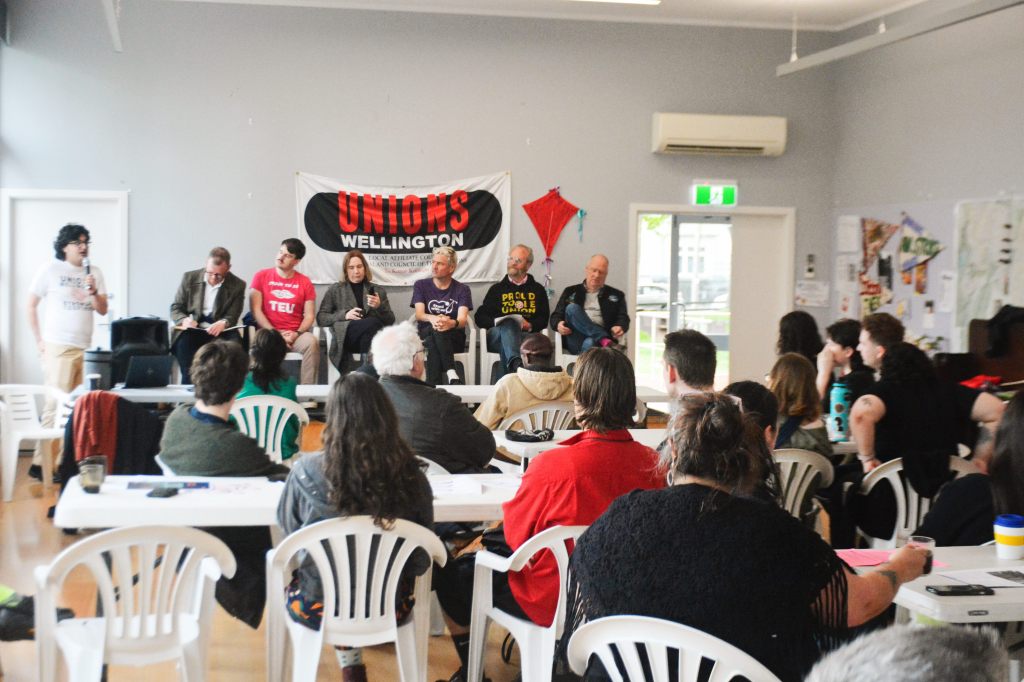
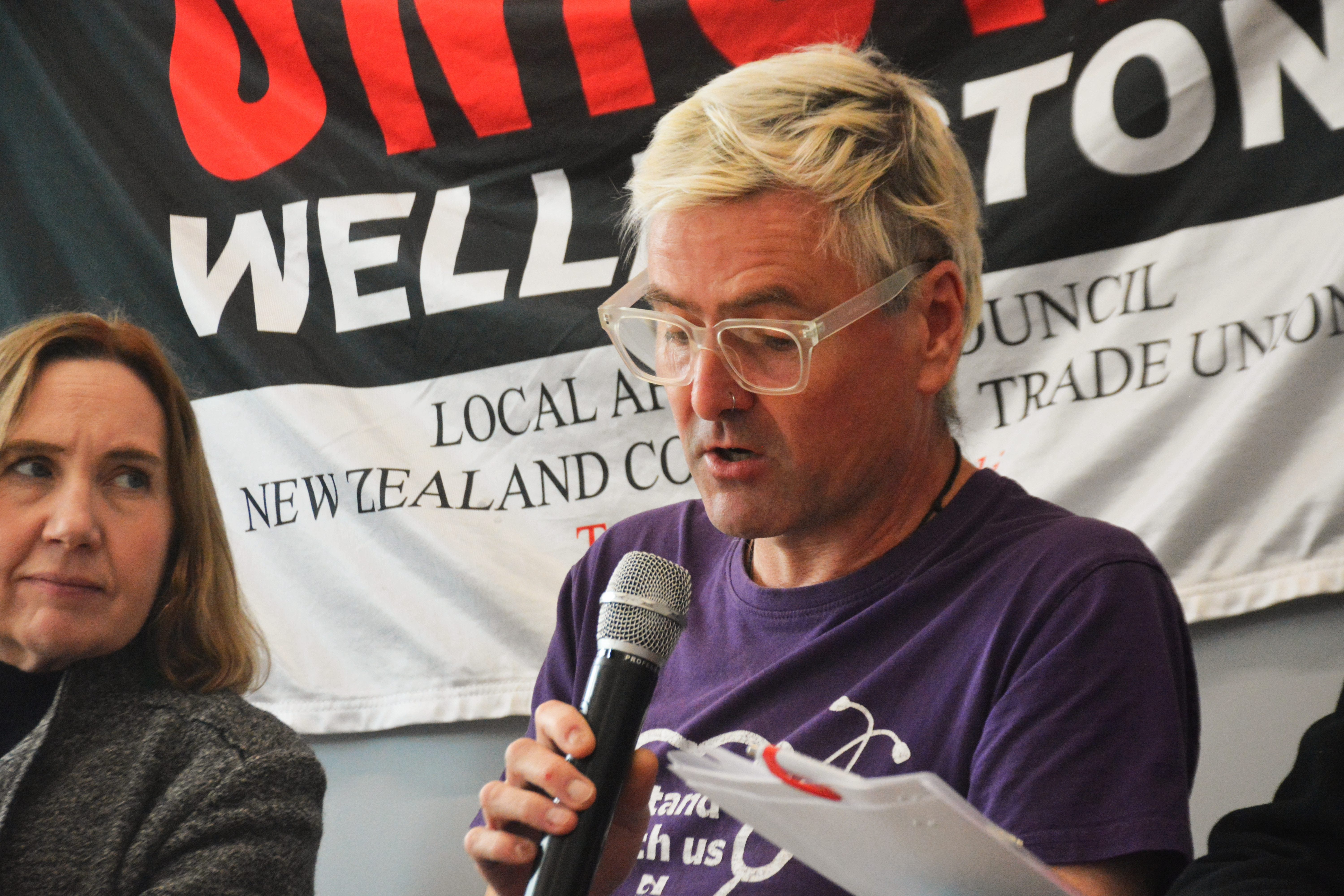
The 23 October public sector strike was the largest industrial action taken in Aotearoa since the one-day General strike in 1979. On 28 October Te Whanganui-a-Tara branch of the International Socialist Organisation hosted a panel discussion on this historic action. Nurse and unionist Grant Brookes was among the speakers, giving his perspective on the struggle. His contributions are published here, edited for clarity.
Grant Brookes is a member of the ISO, a national executive member at Tōpūtanga Tapuhi Kaitiaki New Zealand Nurses Organisation, secretary of Aotearoa Healthcare Workers for Palestine and a member of the Unions Wellington Committee, speaking here in a personal capacity.
The strike last Thursday, with over 100,000 workers, was the largest industrial action taken in Aotearoa since the one-day general strike in 1979. How did we get to this point, and what changes have you noticed inside your own union?
How did we get to this point? Conditions that give rise to struggle like the industrial action last week are shaped by a multitude of factors, which sometimes can only be seen in retrospect. A letter written by German socialist Friedrich Engels late in his life makes the point well:
According to the materialist conception of history, the ultimately determining element in history is the production and reproduction of real life […] The economic situation is the basis, but the various elements of the superstructure political forms of the class struggle and its results, to wit: constitutions established by the victorious class after a successful battle, etc., juridical forms, and even the reflexes of all these actual struggles in the brains of the participants, political, juristic, philosophical theories, religious views and their further development into systems of dogmas — also exercise their influence upon the course of the historical struggles and in many cases preponderate in determining their form […]
In the second place, however, history is made in such a way that the final result always arises from conflicts between many individual wills, of which each in turn has been made what it is by a host of particular conditions of life. Thus there are innumerable intersecting forces, an infinite series of parallelograms of forces which give rise to one resultant – the historical event.
First and foremost, we got to the point of last week’s mass strike through economic conditions – in particular, what’s been dubbed the “cost of living crisis”. Union members, like all workers, are feeling the pinch.
Secondly, there are the “political forms of the class struggle and its results”. These political forms are seen in government actions on the one hand, and the political mobilisations of the working class in all its diversity on the other. I have written about these political forms of the class struggle in arecent article for The Socialist:
In May, the Government took $12.8 billion in budgeted pay equity funding out of working women’s pockets. In June they legalised harsh pay penalties for workers undertaking partial strikes, which are often innocuous actions like wearing union t-shirts or exercising free speech in the media. And this month, Health minister Simeon Brown undermined collective bargaining unlawfully by demanding the senior doctors’ union forget negotiating with Te Whatu Ora and submit to an imposed settlement. The union refused.
After signalling law changes to undermine workers’ democratic rights to free speech, our right to protest, and our right to enrol and vote, this increasingly authoritarian government is again following Donald Trump and is publicly considering draconian law changes to further restrict our legal right to strike across the public sector.
All of this is taking place against the backdrop of mass mobilisations in defence of Te Tiriti o Waitangi and in solidarity with Palestine on a scale never before seen in this country. The historic Hīkoi Mō Te Tiriti last November and the March for Humanity this month are the stand outs. But it’s easy to forget that in between these two mighty pou, other record-breaking uprisings have occurred, such as the 300,000 people who submitted against the ACT Party’s Bill to nullify Te Tiriti, and the weekly unrest over pay equity.
A century ago, Marxist theorist and political leader Rosa Luxemburg observed that:
Every new onset and every fresh victory of the political struggle is transformed into a powerful impetus for the economic struggle, extending at the same time its external possibilities and intensifying the inner urge of the workers to better their position and their desire to struggle. […]
In a word: the economic struggle is the transmitter from one political centre to another; the political struggle is the periodic fertilisation of the soil for the economic struggle.
This combination of factors are some of the “infinite series of parallelograms of forces” which gave rise to last week’s historic public sector general strike.
In terms of the changes I have noticed inside my own union, I can only offer a few anecdotal observations. I have noticed a rise in political awareness among members. This has been seen in more Left Wing policy adopted by members at our NZNO AGM in September. It has also been seen in shifting attitudes towards other groups of workers. I remember back to the teacher strikes in 2021, when some NZNO members didn’t support our union comrades, saying that if the teacher strikes were successful there would be less money in government coffers for nurses. In 2023, some NZNO members attacked striking doctors as “overpaid”.
These narrow, sectional ideas, which fail to see our common interest as workers in standing together against the government, are no longer getting a hearing. Some credit for the shift must go to the firefighters – consistently the most highly trusted occupation,according to regular polls – who have been turning up to every union action, opening the eyes of union members to our shared struggle.
The government has accused unions of “playing politics”, yet in defending gender equity, public services, and Te Tiriti, unions have demonstrated that they have an important part to play in this area. How should we make the argument that politics belongs in union spaces – both within our unions, and to the public?
Health Minister Simeon Brown accused the ASMS union for senior doctors and dentists of “playing politics” when they went on strike in August. Education MinisterErica Stanford accused the NZEI union for primary school staff of “playing politics” last week. Public Service Minister Judith Collins released an open letter saying, “the strike appears to be politically motivated by the unions”, wording later echoed by the Prime Minister. At the same time, government ministers are praising doctors, nurses, teachers and so on.
Their line of attack has two purposes. Firstly, to say that unions are bad and workers are good; unions go on strike and innocent workers are bullied to go along with it – a claim actually madeby Stanford. Secondly, to imply that the Labour Party is pulling the strings. “I appreciate the unions are very close with Labour, I get it, they don’t like our government”, said Luxon, “I get it, but actually they’re not serving their members well.”
In response, we need to say first of all, damned right our strikes are politically motivated. But we ain’t playing.
My own personal goal in going on strike is to help bring down this government and put the opposition parties on notice. And I believe the action I was a part of will be another nail in the government’s coffin. In normal times, the New Zealand public is generally averse to conflict, and a good number of them will see the government as creating this large-scale conflict. I expect the government will take another hit in the polls following the huge public sector general strike last week.
Secondly, we need to keep pointing out that “union” is another name for a group of workers. It was workers who all voted to go on strike last week, not these mythical bugbear “unions” that the government is trying to conjure up. This point is being made widely today – even by traditionally hostile media figureheads like Lloyd Burr.
Thirdly, none of the unions which went on strike last week are affiliated to the Labour Party. And all of them – NZEI, PPTA, ASMS, the PSA and my union – went on strike against the Labour-led government during their last term. The idea that the Labour Party directs union strikes is preposterous.
Finally, following on from the two preceding points, we need to say that “politics” isn’t about the Labour Party or even about parliament. Politics is not the preserve of some elite “political class”, which gets to make all the decisions that the rest of us have to passively accept.
And I actually think it’s easy – and getting easier by the day – to make these arguments about politics in union spaces, because the recent government messaging is directed only at the hard core of their base. The Talbot Mills pollbefore the strike showed two thirds public support and I don’t think the government has won over large swathes of the public since. They’re definitely not winning over union members.
Lloyd Burr’s eyebrow-raising pieceincludes responses from union spokespeople to the government’s accusations:
NZNO bargaining spokesperson Debbie Handisides says it’s on the Government to explain why the strike action is “politically motivated”…
Having the “politically motivated” label slapped on her by those in the very Government she’s negotiating with isn’t going down well with NZNO members, she says.
“It is pretty insulting. And it’s frustrating, very frustrating. We keep going back to the fact they are refusing to listen, and they’re totally not being realistic in refusing to understand what’s happening on the hospital floor”.
Debbie Handisides is not a paid official of NZNO. She is a low-paid enrolled nurse at Burwood Hospital in Christchurch. The article continues:
PPTA President Chris Abercrombie says because his union is negotiating with the Government, the environment is inherently political, regardless of which party is in power.
“I would point out that PPTA members have taken strike action on many occasions when Labour and Labour-led governments have been in power,” he says.
“Issues such as the secondary teacher shortage and the unmet need of students in secondary classrooms are well known by the Government. We are trying, through our collective agreement claims, to get these issues addressed.
“Addressing them is largely a political act. Equally, our strike action, which is in response to the Government’s refusal to address these issues, can be regarded as a political act,” Abercrombie says.
Executive director Sarah Dalton rejects the claim that her union and its members are “politically motivated”.
“ASMS is not party political, but we’re absolutely health political, and that’s clearly stated in our constitution. Our constitution requires us to advocate for the best public health system we can in New Zealand,” she says.
From these starting points, it’s relatively easy to press on and to argue that gender equity, public services, Te Tiriti, peace and Palestine are all political issues that belong in union spaces.
One of the clearest arguments for why politics belongs in union spaces came from Chlöe Swarbrick. Marching with the striking workers in Tāmaki Makaurau last week,she said, “Of course this is political. Politics is about power and it’s about resources and it’s about who gets to make decisions that saturate and shape our daily lives. And the Greens proudly, vehemently believe that workers should be involved in making decisions about how our economy works”.
Recently we saw Judith Collins attack the secondary teachers’ union for putting Palestine as “the number one item on their agenda” for a negotiation meeting with the Education Minister. Collins is clearly misleading the public here, as the union was asked to bring forward issues separate from bargaining, but this still shows workers are keen to support issues beyond the workplace. Why is it so important for unions to fight for Palestine, and what role do they play in the wider struggle for peace?
There are a range of valid reasons why it’s important for unions to fight for Palestine. I think it’s useful to talk about the range of reasons, because a union is a broad church for members of varying political persuasions.
Firstly, fighting for Palestine involves educating public sector union members on why it matters to care about other people in need who are in some ways different from themselves. This is about recognising shared humanity, which is a fairly basic liberal tenet, but this education also flows progressively back into supporting ethnic and gender minorities in Aotearoa; supporting non-unionised workers in the private sector; supporting members of other public sector unions; supporting lower paid members of our own union and supporting unionised professionals in workplaces different from our own.
In short, fighting for Palestine is part of developing a mass psychology of solidarity among our union’s membership, which is key to any union’s strength.
Another reason to fight for Palestine is to avoid entrapment in pro-US policies, chief among which was Trump’s 2024 demand on US allies to increase military spending to three percent of GDP – a demand Trump later increased to five percent of GDP in 2025. The New Zealand government has capitulated to Trump’s demands for increased spending, doubling the military budget by 2029 with $12 billion of extra funding. Every dollar spent on war, of course, is a dollar less spent on security of public services for New Zealanders. Fighting for Palestine helps to see where the real enemies are and equips union members to resist the scaremongering of defence minister Judith Collins.
Further reasons for fighting for Palestine are contained in this email I sent to the NZNO Board and Chief Executive in November 2023, kicking off NZNO’s solidarity efforts:
Kia ora koutou,
Thank you [redacted] for this response to the upheaval around Gaza. I welcome your decision to hold a Board meeting asap to consider NZNO’s position. In advance of that, I would like to share what I think are a few of the salient issues.
While in San Francisco, [redacted] and I noted in conversation the strong moral purpose which guided the California Nurses Association. Sustaining this moral purpose over the long term is one of the sources of that union’s strength, motivating members to take action today in a wide range of difficult circumstances – much more difficult than any we have faced, in recent memory.
Within NZNO, in addition to the motion passed by our Wellington Te Whatu Ora delegates, other delegate meetings will be considering motions on Palestine in the coming days. Hundreds of our members have signed ahealthcare workers’ call for an immediate ceasefire in Gaza(only a fraction of which are showing on the website at the moment). No doubt, the vantage point of the NZNO Leadership Team means they will know much more about this current context. I look forward to [redacted] background words for our Board meeting.
In such a context as this, when our close allies and members are speaking out, saying nothing about the humanitarian crisis would represent a moral position for NZNO. This is not a position I would support. I am also concerned that staying silent would carry repetitional risks for NZNO.
In the wider context, it is my personal take that the current upheaval in Gaza represents an inflection point in world history, which will have far-reaching international and domestic ramifications – much like the attack on the World Trade Centre in New York in 2001. As the acclaimed documentaryOperation 8: Deep in the Forest made clear, the “War on Terror” launched by US President George Bush in response to that terrorist attack led directly to the passage of the Terrorism Suppression Act 2002 by Helen Clark’s Labour Government, and then to the “terror raids” in Te Urewera five years later.
Te Pāti Māori understand the historical significance of the Gaza War for Māori. So does the ACT Party, which is targeting people calling for the decolonisation of Palestine as “terrorists”, at the same time as pushing for their referendum on the principles of the Treaty of Waitangi [sic.].
We as a Board are aware that NZNO will be facing difficult circumstances over the next three (or more) years – especially for our moral stand to deepen our commitment to Te Tiriti o Waitangi. Solidarity forged now over the linked issue of Palestine with our close allies – and with our more conscientious members – are what we’re going to need to get us through.
Ngā mihi
Grant
What challenges do you expect to face heading into the next few months, and what lessons or tactics will be the most important for facing them?
It appears to me that the government has badly bungled its approach to public sector workers. At the start of the year, I told a meeting of this group that a challenge for NZNO was sustaining the willingness of members to take action, after some lacklustre rolling strikes in the lead-up to Christmas. The government has now antagonised nurses so much that this is not a challenge heading into the next few months.
For senior doctors and dentists, demands on ASMS to abandon bargaining and submit to binding arbitration have been ignored. Legal action against ASMS strikes by government lackeys at Te Whatu Ora is almost certain to fail. Threats to change the law to remove our right to strike have faded for now, as we called their bluff – although we must be alert to the possibility that the probable failure of the legal action against ASMS could be used to build a case to change the law next year. Meanwhile, their attempts to demonise unions have backfired spectacularly, as union density (the proportion of workers across the economy who are unionised) hasreversed its long decline and risen to the highest level in 15 years.
This bungling is due in part to the fact that none of the current generation of government politicians (except for Winston Peters) have ever experienced a strike wave. But there is always a chance they will learn from their mistakes, and heed advice from experienced union-busters.
Our success as workers – as always – has been in our unity. The challenges we should prepare for are efforts to divide and conquer. So far [at the time of this panel] only two very small public sector unions have been persuaded to settle their collective bargaining – MERASmidwives union and a breakaway union for a few primary school principals. One option for the government is to break our unity by buying off the members of one union with a more generous offer, while holding the line with the others and painting them as somehow “bad” for not settling. This would be costly, and risky for them. In response to this possible challenge, the lesson for the others will be to hold out for an offer at least as good.
In a few words, please tell us what everyone in this room can do to support the strikes.
NZNO is balloting this week on our next round of nationwide strikes, which are scheduled to take place between 17-30 November. Members are voting on three different actions, to take place over this period. These are all partial strikes, which means that members are voting on whether to reduce the normal performance of their duties while still providing care for the patients in their area of work. If these partial strikes go ahead, therefore, there won’t be public rallies or marches to join. If we want opportunities to publicly show our support for these strikes, therefore, we will have to make them ourselves.
Other unions (including the PSA) have signalled new strikes which may feature rallies and marches which all supporters can join. And for supporters in unions which are not striking, there is another, more powerful way to support. Section 26 of the Employment Relations Act provides for two paid stopwork meetings per year, for all unions. These member meetings are sometimes needed for a union’s planned organising work. But often they aren’t fully used. So supporters in unions which aren’t on strike can call for their union to hold a stopwork meeting on the day. Finally, NZNO is also looking ahead to next year and planning for possible strikes in February, so look out for those. In the meantime, we are calling on people to sign onto the Buller Declaration, a petition from Patient Voice Aotearoa due to be presented to parliament next month. A link to the petition is on the home page of our website, nzno.org.nz.
People may have heard that the government has increasingly outsourced hospital procedures to private hospitals in order to meet care targets, often at great expense. Why would they do this rather than investing in capacity in the public system?
First up, it’s important to stress at the outset that government outsourcing in the health sector isn’t limited to hospital procedures, and the risks aren’t just related to expense. Outsourcing of surgery has captured most of the headlines, but the privatisation drive is just as intense in medical imaging, telehealth, medical laboratories, diagnostic procedures and in other areas too.
The many damaging consequences of all this outsourcing have been widely publicised. They include:
Disrupting the training pipeline for surgeons, by diverting the straightforward cases where trainee surgeons develop their skills away from the public hospitals where they all work and where their training takes place.
Risk of critical failures in telehealth, with health minister Simeon Brown removing the requirement that Primary Health Organisations must be not-for-profit trusts and awarding the national telehealth contract to a private corporation with no previous health experience, set up by the people behind My Food Bag which collapsed spectacularly after listing on the sharemarket.
Potential collapse of X-Ray services and other scanning procedures in public hospitals, as highlighted by a report from the APEX union last month which found that $140 million was funneled to private imaging companies in the last year – more than the entire budget for the public hospital workforce.
I could go on. But the question is – why would the government outsource like this? The answer depends who you ask, and when you ask.
Despite the principle of collective Cabinet responsibility being enshrined the Cabinet Manual, the three headed taniwha government does not speak with a single voice. Ministers and MPs from coalition parties are freely floating their own thoughts on health privatisation, despite the fact it was never mentioned in the “agree to disagree” clauses in their coalition agreements.
So there is no single agreed reason for why the government is outsourcing. Let’s start with the shifting reasons given by health minister Simeon Brown this year for outsourcing surgical procedures.
Brown’s rationale for these long-term contracts for elective surgery was “fiscal responsibility”. “The small amount of planned care that is outsourced to the private sector”, he said, “is often done on an ad hoc basis, meaning Health New Zealand is paying premium prices.”
This is not true. Te Whatu Ora does not pay premium prices. Bowen Hospital, the private surgical hospital in Crofton Downs, for instance takes surgical cases funded by ACC, by private health insurance companies and by Te Whatu Ora. I have received financial information showing that Te Whatu Ora pays the lowest prices for procedures out of these three funders. The Private Hospitals Association is pressuring the government to increase the low prices for cases referred by Te Whatu Ora under Simeon Brown’s new long term contracts.
And in 2024, Te Whatu Ora abruptly cancelled its contract with the Christchurch Charity Hospital for outsourced surgery, refusing to give a reason. Instead it gave the work to the for-profit facilities in the city – St George’s Hospital, Southern Cross Hospital, Christchurch Eye, and Forte Hospital. These contracts mean that Te Whatu Ora is now paying more for the same procedures at private hospitals in 2025 than it was paying at the Charity Hospital in 2024. So the “fiscal responsibility” reason for outsourcing doesn’t hold water, either.
Then in June, Brown highlighted a different reason again for outsourcing surgery to the private sector. Having spent the $50 million announced in March, the government announced another cash handout for 60 private hospitals to perform a further 21,000 elective procedures. Casting further doubt on the rationale of “fiscal responsibility”, they withheld price information for this new plan. But Brown said, “Health New Zealand is partnering with private hospitals to expand surgical capacity across the country.”
Even the most cursory examination of this rationale shows that it doesn’t stack up, either. Responses from clinicians and government officials alike have all pointed out that the same surgical teams who work in private hospitals also work public hospitals. So performing more elective procedures in private simply means that there will be less surgical capacity in the public system.
Some of the most telling exposures of this false rationale is have come from senior doctors. Dr David Bailey, lead obstetrician-gynaecologist for the Northland region, pointed out that there was surplus surgical capacity at Whangārei Base Hospital, with operating theatres siting idle in the weekends, yet Te Whatu Ora was sending his surgical patients to a private hospital instead. Another senior doctor at Nelson Hospital said the same thing on 1News.
“We know that this is costing a very large amount of money with no transparency”, said Dr Bailey, “whereas we would do these procedures in the public hospital, maybe as additional lists on the weekend for a fraction of the money in theatres which are sitting unused.” The push to private, he said, appeared to be “entirely ideological”.
Which brings us to another head of the taniwha government. David Seymour has given a completely different reason for outsourcing to the private sector – one which is at odds with his coalition partner.
Simeon Brown has been at pains to repeat that despite all the outsourcing, “the system remains publicly funded, so everyone has access.”
On the other hand, in Seymour’s so-called “state of the nation speech” this year, he proposed that people should “give up their right to the public healthcare system”. “Should we allow people to opt out of the public healthcare system”, he suggested, “and take their portion of funding with them so they can go private?”
Thankfully, most health sector unions – including the PSA, ASMS, NZRDA and APEX – are implacably opposed to the government’s privatisation agenda. My own union adopted a new, strong position statement on public versus private healthcare at our AGM last month.
But I do need to mention that one union is working with the government on their outsourcing plans. At the beginning of this kōrero, I pointed out that one damaging consequence of privatisation is the disruption of training for surgeons, by diverting the straightforward cases away from the public hospitals where their training takes place. One of the two unions for trainee doctors, Speciality Trainees of New Zealand (STONZ), is setting up a training agreement between private hospitals and the Royal Australasian College of Obstetrics and Gynaecology. “Some people might snub their noses at the fact that we’re supporting the private sector”, says STONZ president Jordan Tewhaiti-Smith, “but actually it’s a much bigger lens that I think we should look through.”
I would respectfully reply to my union comrade that the bigger lens we should look through is the one highlighted in the negative by David Seymour – our fundamental right to a public healthcare system.
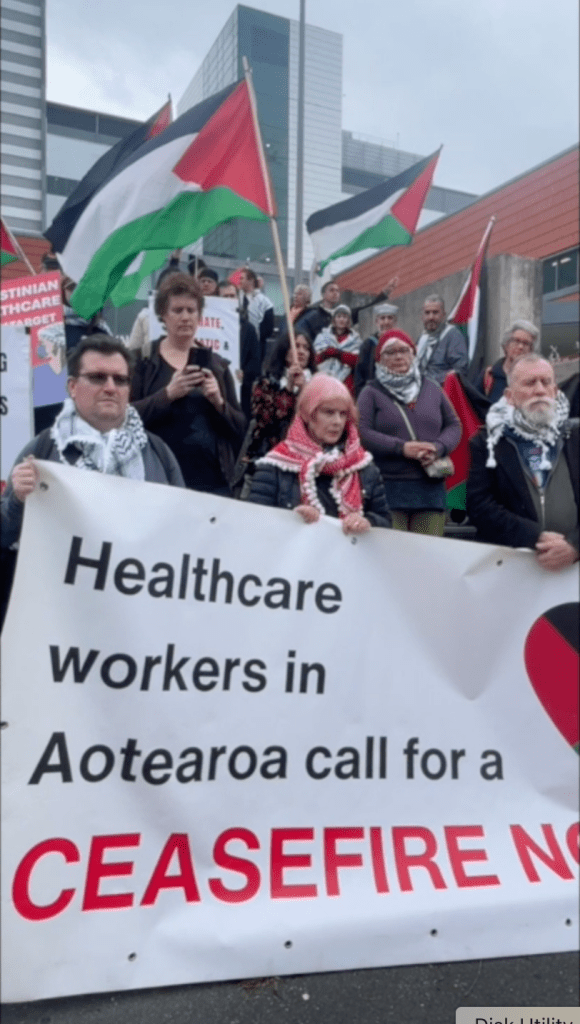
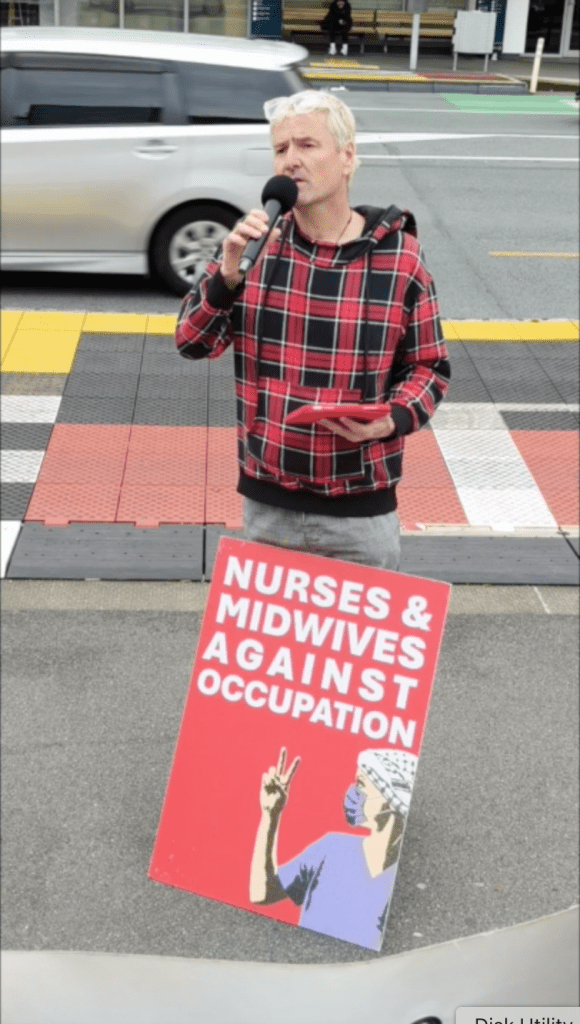
Thank you all for coming to this event which we hold every month outside Wellington Regional Hospital Ngā Puna Wairoa, organised by Aotearoa Healthcare Workers for Palestine. As you might notice, I am not Serena Moran. The Chairperson of our group is currently away on holiday so I am stepping in. My name is Grant Brookes. I’m a Mental Health Nurse here in Wellington, and it’s my task after our opening karakia to offer some thoughts about what’s been going on over the last month.
I’m sure that many of us here have been glued to our screens for the last 24-48 hours, following the progress of those brave souls on the Global Sumud Flotilla – and thinking in particular of young Samuel Leason, and our Kiwi compatriots Yousef Sammour and Rana Hamida. As of right now, we’re still in the dark about their safety, somewhere in Israel.
But also in the last week, we’ve heard the news about Trump and Netanyahu’s 20-point plan, which has been laughingly described as a “peace plan”.
Just when you thought prospects for people in Gaza could not get any worse, Trump is proposing himself as the chair of a corporate board that will serve as a transitional government in the enclave.
But this isn’t all. Also on board is war criminal Tony Blair, who will reportedly play a significant role in the future government of Gaza. This is colonialism in a region that already knows far too much about that.
Earlier this year, The Tony Blair Institute was part of a project which envisaged rebuilding a post-war Gaza as a trading hub. His plan was for a “Trump Riviera” and an “Elon Musk Smart Manufacturing Zone”. Hamas, we’ve been told, has been given until today to accept this dystopian future.
We should make no mistake, the future of the whole world is being fought over in Gaza.
Because as Anthony Loewenstein says in his book, The Palestine Laboratory, Israel’s military industrial complex has used the occupied Palestinian territories as a testing ground for weaponry and methods of control by corporate overlords that then are exported all around the world.
For more than 50 years, the occupation of the West Bank and Gaza has given the Israeli state invaluable experience in controlling what they term an “enemy” population. Toady, that is the Palestinians. Tomorrow it’s going to be Trump’s “internal enemy” in Democrat-run cities and states across America. And the day after that, for all we know it could be us.
This is just one of the reasons why we continue to stand with Gaza and resist the humiliation and degradation of Palestinians at the hands of the occupation forces and the apartheid state.
As healthcare workers, it is our professional colleagues especially who we stand with.
Over the last week, the world heard from a small team Australian doctors working in Gaza. We heard from the firstly because they went viral on TikTok and then because they were broadcast internationally by Al Jazeera. One of them, Dr Saya Aziz, described her hospital as “like an abattoir”, but then she added that even in an abattoir there are some hygienic methods of killing. Her Australian colleague Dr Nada Abu Alrub said their hospital had zero stock – not even soap for them to wash their hands before tending to patients. “We need to stop the killing”, she said.
That same day she gave that interview to Al Jazeera, a nurse at Nasser Hospital in Khan Younis, Marwan Abdeen, was shot in the head through a hospital window while he was working. Marwan thankfully has survived.
But Omar Hayek, an Occupational Therapist at the MSF field hospital in Deir Al-Balah, was killed in an Israeli strike yesterday. He was waiting in the street for a bus to take him to work. Four other healthcare workers were seriously injured, including a physiotherapist, an orthopaedic surgeon, a supply officer and a finance assistant.
And at the start of this week, the chief nursing officer at Kamal Adwan Medical Complex and the leader of the Palestinian Nursing Association, Dr Akram Al-Kafarneh, was killed by occupation forces.
MSF reports that over 1,500 health workers and hundreds of humanitarian workers have been killed in Gaza since October 2023.
But as we know, the resistance to Israel’s slaughter and genocide is growing. The massive general strike we saw in Italy last week was an inspiration, in shutting down the ports that supply Israel. Italian unions have called another general strike for next week, and Europeans across the Continent have taken to the streets to protest and blockade today.
Even here in Pōneke, we can celebrate the Academic Senate up at Te Herenga Waka Victoria University voting unanimously last week for the university to boycott, divest and sanction Israel. This win followed a long campaign by members of the Tertiary Education Union and activists with Students for Justice in Palestine.
The result of pressure from these grassroots campaigns is now being seen at the very highest level, with 77 nations walking out on Netanyahu’s speech at the UN General Assembly in New York.
Inspired by this, we keep standing up for Gaza, for humanity and indeed for our own future.
So let us now remember our healthcare colleagues murdered by Israel, as well as the hundreds currently in Israeli detention, by reading aloud their names.
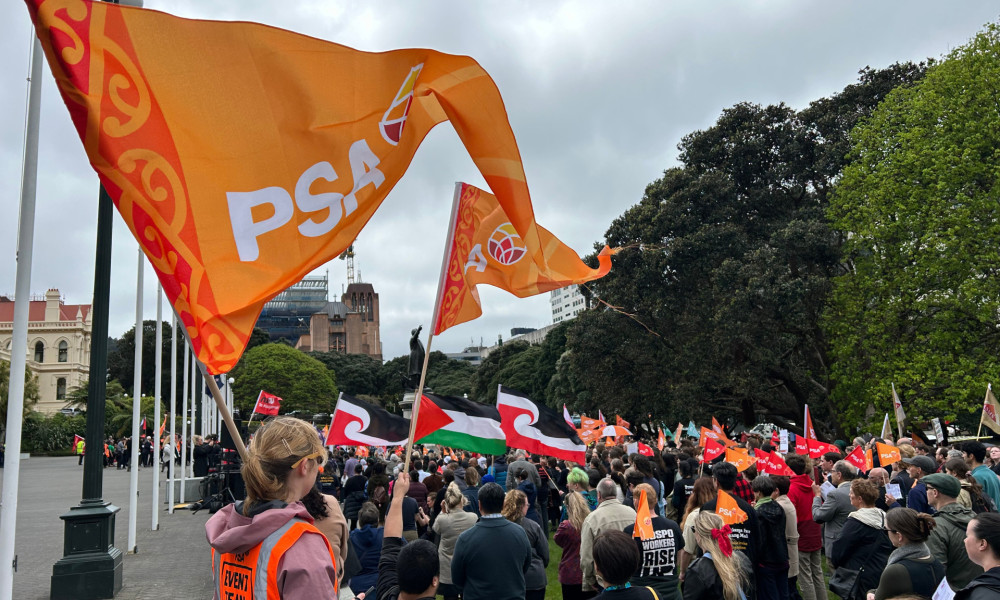
Caption: Trade union, Palestine, and Tino Rangatiratanga flags at parliament, showing the convergence of Māori, pro-Palestine and workers’ struggles. Photo Credit: Public Service Association.
“The year of the strike? Perfect pay storm looms over public sector.” This was the headline of an article back in February by a prescient Stuff journalist.
This perfect storm has arrived, though it’s about much more than pay. Under conditions of today’s unprecedented political mobilisations, and an increasingly authoritarian government which has thrust the right to strike into the foreground, the current strike wave has the potential to develop into a force which reshapes the political landscape of Aotearoa.
Tertiary educators, ministry staff, senior doctors and dentists, nurses, firefighters, secondary teachers, primary teachers, and allied health professionals have all either taken strike action in support of collective bargaining this year, or have voted on it.
And despite the large-scale deunionisation of the private sector, strikes have also broken out this year in places as diverse as private medical laboratories, McDonald’s, aged care facilities, Briscoes, Rebel Sport, Stuff newsrooms, and Christchurch City Council.
As the predicted perfect storm breaks, the Coalition government is closing the door on mechanisms for fixing gender-based pay disparities outside of collective bargaining, intervening illegally in union negotiations, and ramping up its political attacks on the right to strike.
In May, the Government took $12.8 billion in budgeted pay equity funding out of working women’s pockets. In June they legalised harsh pay penalties for workers undertaking partial strikes, which are often innocuous actions like wearing union t-shirts or exercising free speech in the media. And this month, Health minister Simeon Brown undermined collective bargaining unlawfully by demanding the senior doctors’ union forget negotiating with Te Whatu Ora and submit to an imposed settlement. The union refused.
All of this is taking place against the backdrop of mass mobilisations in defence of Te Tiriti o Waitangi and in solidarity with Palestine on a scale never before seen in this country. The historic Hīkoi Mō Te Tiritilast November and the March for Humanity this month are the stand outs. But it’s easy to forget that in between these two mighty pou, other record-breaking uprisings have occurred, such as the 300,000 people who submitted against the ACT Party’s Bill to nullify Te Tiriti, and the weekly unrest over pay equity.
It’s also easy to forget that the convergence and mutual support between the Palestine solidarity campaign, Māori resistance, and the trade union movement in 2025 – which now seems like common sense – is also completely unprecedented.
Despite their predominantly working class base, Te Pāti Māori pursued a strategy of alliances with the National Party from its inception until 2017. Never once did they come out in support of public sector unions, and only rarely did they support private sector union struggles by Māori workers. It wasn’t until 2021 that new party leaders Debbie Ngārewa-Packer and Rawiri Waititi stood for the first time with striking public sector workers – something which has now become routine.
Union support for indigenous rights has often meant little more than lip service. Now, for the first time, the NZCTU Te Kauae Kaimahi is organising a nationwide mobilisation against political, legal, and cultural attacks on Māori – Te Rā Whakamana – jointly with the National Iwi Chairs Forum.
Despite the best efforts in the 2000s by the late CTU President Helen Kelly, the union movement has been slow to support Palestine. As late as 2023, a cautious Resolution on the Palestine/Israel Conflict – which condemned Hamas as well as Israel – was almost scuppered by Zionist union leaders. At last, in 2025, there are no pro-Israel voices and unions are united in backing the history-making protests.
Within Māori politics, there used to be a small minority of high profile figures in the Māori Party and the Mana Party who were outspoken supporters of Zionism. At Waitangi in 2013, the Israeli flag flew alongside the Mana Party flag, Tino Rangitiratanga flag, the United Tribes flag, and signage promoting Mana Party leader Hone Harawira. Today, prominent commentator Tina Ngata is able to declare: “there is [effectively] no indigenous support for Israel.” Palestine supporters are backing Māori in return.
Thanks to the ceaseless pulse of protest in 2025, all of this is visible on a daily basis: Tino Rangatiratanga flags on picket lines, keffiyehs on the marae, and union banners on marches for Gaza.
A century ago, Marxist theorist and political leader Rosa Luxemburg examined what can happen when, under conditions of authoritarian government, a strike wave which begins over wages connects with political mobilisations like this. In her classic work, The Mass Strike, she observed that:
In the peaceful, “normal” course of bourgeois society, the economic struggle is split into a multitude of individual struggles in every undertaking and dissolved in every branch of production. On the other hand the political struggle is not directed by the masses themselves in a direct action, but in correspondence with the form of the bourgeois state, in a representative fashion, by the presence of legislative representation.
But “as soon as the masses appear on the scene of conflict, the breaking up the economic struggle into many parts, as well as the indirect parliamentary form of the political struggle ceases.”
Every new onset and every fresh victory of the political struggle is transformed into a powerful impetus for the economic struggle, extending at the same time its external possibilities and intensifying the inner urge of the workers to better their position and their desire to struggle. […]
In a word: the economic struggle is the transmitter from one political centre to another; the political struggle is the periodic fertilisation of the soil for the economic struggle.
In a mass strike, the underlying reality comes into view:
There are not two different class struggles of the working class, an economic and a political one, but only one class struggle, which aims at one and the same time at the limitation of capitalist exploitation within bourgeois society, and at the abolition of exploitation together with bourgeois society itself.
Although moves to abolish capitalist exploitation in Aotearoa are unlikely in the near future, we are witnessing a major escalation of working class struggle. In many cases, the strikes of 2025 in Aotearoa are unprecedented in terms of duration, frequency, or coordination. Senior doctors and dentists have walked off the job more often and for longer than ever before., Nurses have been on strike 31 times in the last 12 months and have taken nationwide action twice in the same week for the first time. Simultaneously, opinion polls are showing strong public support for the defence of public services.
In May, in an early indication of where the current strike wave is heading, nurses and doctors at Auckland City Hospital walked off the job together in an unprecedented joint strike.
In yet another historic first, primary school teachers, primary principals, school support staff, and Ministry of Education specialist staff will all strike together on 23 October to urge the Government to address students’ and educators’ issues in education. As The Socialistgoes to press, discussions are taking place between public sector unions about making this date a mass strike for all. This would be the first such general strike in Aotearoa since 1979.
The government is going all out on attacking our right to strike, because they dimly grasp the potential of such a mass public sector strike to not only break their grip on power, but also to force changes far beyond what the Labour opposition would like to offer and press to wider liberation for Māori, for Palestine, for women, and for others. Our task as socialists is to act urgently on Rosa Luxemburg’s words: “If the mass strike, or rather, mass strikes, and the mass struggle are to be successful they must become a real people’ s movement, that is, the widest sections of the proletariat must be drawn into the fight.”


 Grant Brookes | Nurse & Trade Unionist