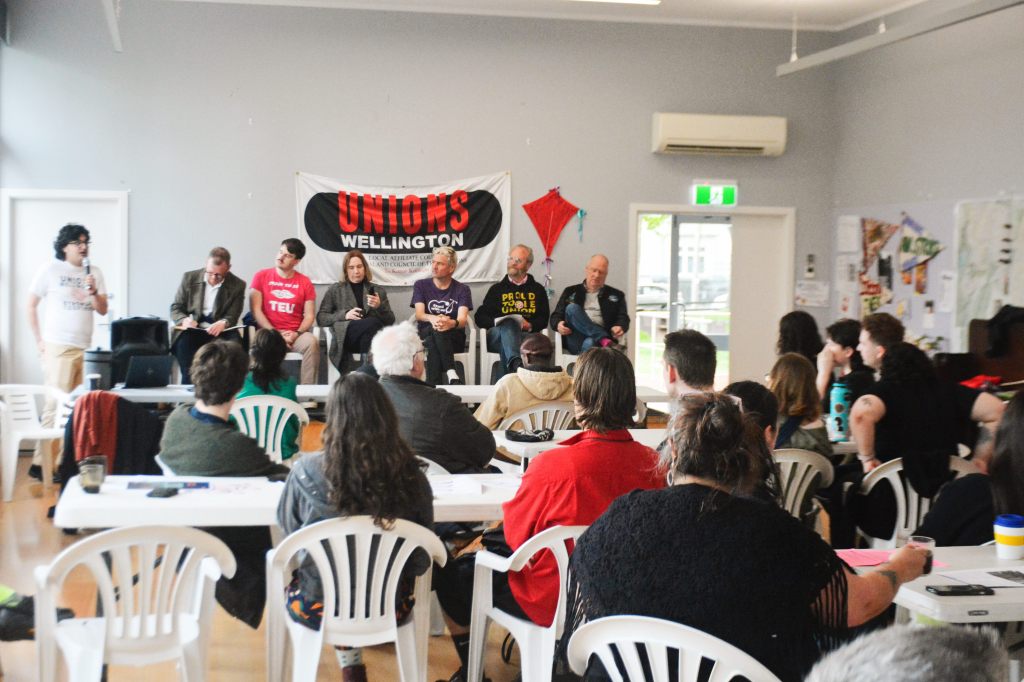
Unions Wellington asks:
- People may have heard that the government has increasingly outsourced hospital procedures to private hospitals in order to meet care targets, often at great expense. Why would they do this rather than investing in capacity in the public system?
First up, it’s important to stress at the outset that government outsourcing in the health sector isn’t limited to hospital procedures, and the risks aren’t just related to expense. Outsourcing of surgery has captured most of the headlines, but the privatisation drive is just as intense in medical imaging, telehealth, medical laboratories, diagnostic procedures and in other areas too.
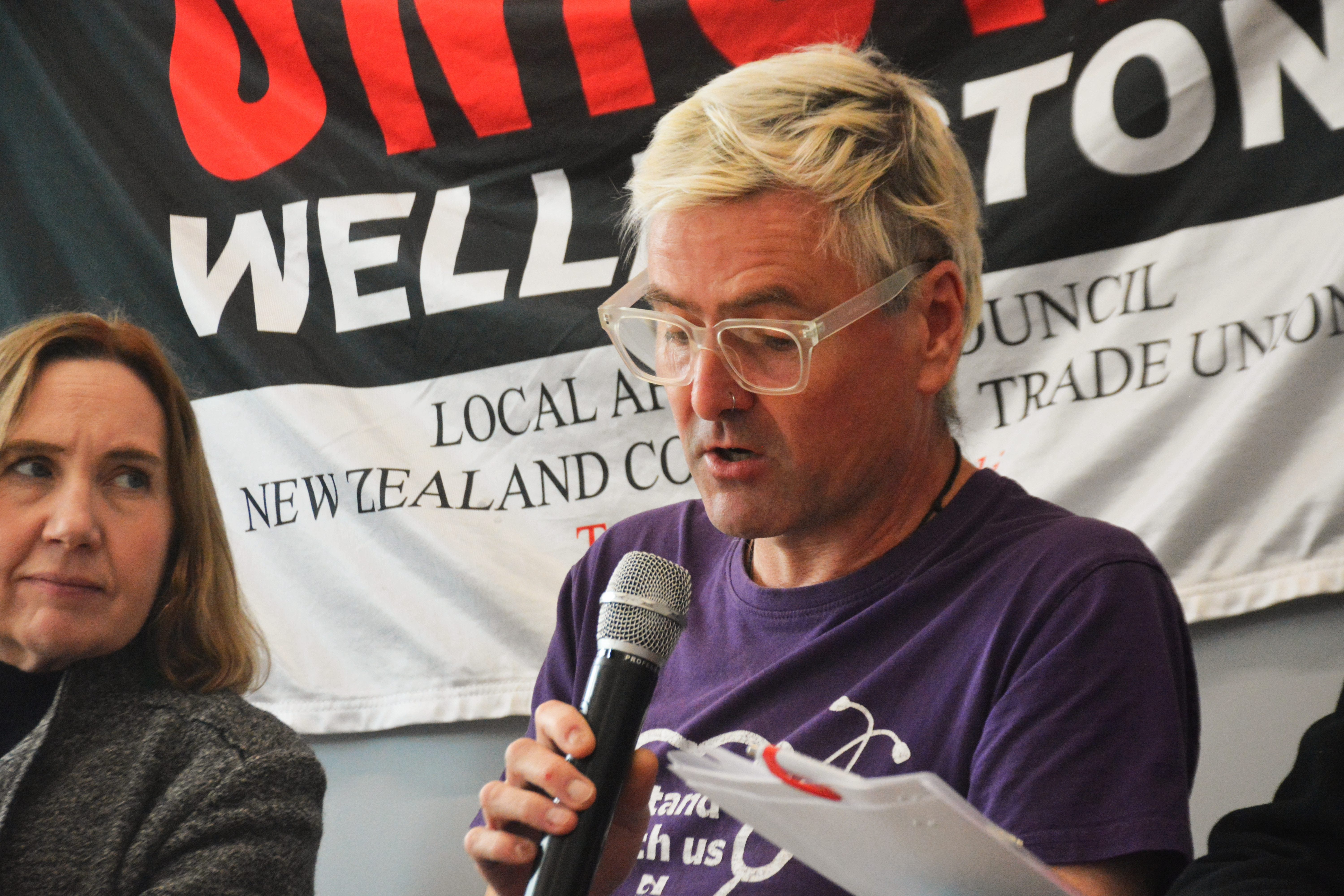
The many damaging consequences of all this outsourcing have been widely publicised. They include:
- Disrupting the training pipeline for surgeons, by diverting the straightforward cases where trainee surgeons develop their skills away from the public hospitals where they all work and where their training takes place.
- Risk of critical failures in telehealth, with health minister Simeon Brown removing the requirement that Primary Health Organisations must be not-for-profit trusts and awarding the national telehealth contract to a private corporation with no previous health experience, set up by the people behind My Food Bag which collapsed spectacularly after listing on the sharemarket.
- Potential collapse of X-Ray services and other scanning procedures in public hospitals, as highlighted by a report from the APEX union last month which found that $140 million was funneled to private imaging companies in the last year – more than the entire budget for the public hospital workforce.
I could go on. But the question is – why would the government outsource like this? The answer depends who you ask, and when you ask.
Despite the principle of collective Cabinet responsibility being enshrined the Cabinet Manual, the three headed taniwha government does not speak with a single voice. Ministers and MPs from coalition parties are freely floating their own thoughts on health privatisation, despite the fact it was never mentioned in the “agree to disagree” clauses in their coalition agreements.
So there is no single agreed reason for why the government is outsourcing. Let’s start with the shifting reasons given by health minister Simeon Brown this year for outsourcing surgical procedures.
Announcing a $50 million subsidy for private surgical hospitals in March, Brown said that the reason was to clear a backlog of 10,000 elective surgery cases by June this year. This rationale simply doesn’t pass the sniff test, because at the same time his letter of expectation to Commissioner Lester Levy directed him to enter into three year contracts (later extended to 10 year contracts) with private hospitals. If the real reason was to clear an urgent backlog, why plan to lock in funding which is practically permanent?
Brown’s rationale for these long-term contracts for elective surgery was “fiscal responsibility”. “The small amount of planned care that is outsourced to the private sector”, he said, “is often done on an ad hoc basis, meaning Health New Zealand is paying premium prices.”
This is not true. Te Whatu Ora does not pay premium prices. Bowen Hospital, the private surgical hospital in Crofton Downs, for instance takes surgical cases funded by ACC, by private health insurance companies and by Te Whatu Ora. I have received financial information showing that Te Whatu Ora pays the lowest prices for procedures out of these three funders. The Private Hospitals Association is pressuring the government to increase the low prices for cases referred by Te Whatu Ora under Simeon Brown’s new long term contracts.
And in 2024, Te Whatu Ora abruptly cancelled its contract with the Christchurch Charity Hospital for outsourced surgery, refusing to give a reason. Instead it gave the work to the for-profit facilities in the city – St George’s Hospital, Southern Cross Hospital, Christchurch Eye, and Forte Hospital. These contracts mean that Te Whatu Ora is now paying more for the same procedures at private hospitals in 2025 than it was paying at the Charity Hospital in 2024. So the “fiscal responsibility” reason for outsourcing doesn’t hold water, either.
Then in June, Brown highlighted a different reason again for outsourcing surgery to the private sector. Having spent the $50 million announced in March, the government announced another cash handout for 60 private hospitals to perform a further 21,000 elective procedures. Casting further doubt on the rationale of “fiscal responsibility”, they withheld price information for this new plan. But Brown said, “Health New Zealand is partnering with private hospitals to expand surgical capacity across the country.”
Even the most cursory examination of this rationale shows that it doesn’t stack up, either. Responses from clinicians and government officials alike have all pointed out that the same surgical teams who work in private hospitals also work public hospitals. So performing more elective procedures in private simply means that there will be less surgical capacity in the public system.
Some of the most telling exposures of this false rationale is have come from senior doctors. Dr David Bailey, lead obstetrician-gynaecologist for the Northland region, pointed out that there was surplus surgical capacity at Whangārei Base Hospital, with operating theatres siting idle in the weekends, yet Te Whatu Ora was sending his surgical patients to a private hospital instead. Another senior doctor at Nelson Hospital said the same thing on 1News.
“We know that this is costing a very large amount of money with no transparency”, said Dr Bailey, “whereas we would do these procedures in the public hospital, maybe as additional lists on the weekend for a fraction of the money in theatres which are sitting unused.” The push to private, he said, appeared to be “entirely ideological”.
Which brings us to another head of the taniwha government. David Seymour has given a completely different reason for outsourcing to the private sector – one which is at odds with his coalition partner.
Simeon Brown has been at pains to repeat that despite all the outsourcing, “the system remains publicly funded, so everyone has access.”
On the other hand, in Seymour’s so-called “state of the nation speech” this year, he proposed that people should “give up their right to the public healthcare system”. “Should we allow people to opt out of the public healthcare system”, he suggested, “and take their portion of funding with them so they can go private?”
Thankfully, most health sector unions – including the PSA, ASMS, NZRDA and APEX – are implacably opposed to the government’s privatisation agenda. My own union adopted a new, strong position statement on public versus private healthcare at our AGM last month.
But I do need to mention that one union is working with the government on their outsourcing plans. At the beginning of this kōrero, I pointed out that one damaging consequence of privatisation is the disruption of training for surgeons, by diverting the straightforward cases away from the public hospitals where their training takes place. One of the two unions for trainee doctors, Speciality Trainees of New Zealand (STONZ), is setting up a training agreement between private hospitals and the Royal Australasian College of Obstetrics and Gynaecology. “Some people might snub their noses at the fact that we’re supporting the private sector”, says STONZ president Jordan Tewhaiti-Smith, “but actually it’s a much bigger lens that I think we should look through.”
I would respectfully reply to my union comrade that the bigger lens we should look through is the one highlighted in the negative by David Seymour – our fundamental right to a public healthcare system.
 Grant Brookes | Nurse & Trade Unionist